
Easter eggs are specially decorated eggs given out to celebrate the Easter holiday or springtime.
It is the influence of the traditional spring rites that made Easter so egg-special. And myths coming down to us from an incredibly distant past have shown man's relationship with the egg to be very deep seated one.  This is caught in old Latin proverb: "Omne vivum ex ovo". This means "all life comes from an egg". Not just the Latin saying, eggs are just laid well over all corners of the world. From ancient India to Polynesia, from Iran, Greece, and Phonecia to Latvia, Estonia, and Finland, from Central America to the west coast of South America, there are reports of myths of the whole universe created out of an egg. Thus, it is not unusual that in almost all ancient cultures eggs had been held as an emblem of life. The concept of all living beings born from an egg is also a foundational concept of modern biology.
But how did eggs come to be associated with Easter?
Despite claims being made that Easter Eggs were originally pagan symbols, there is no solid evidence for this. It was not until the 18th Century that Jakob Grimm theorised a putative pagan connection to Easter Eggs with a goddess of his own whom he named Ostara, a suggested German version of Eostre.
At the Passover Seder, a hard-boiled egg dipped in salt water symbolizes both new life and the Passover sacrifice offered at the Temple in Jerusalem. The ancient Persians painted eggs for Nowrooz, their New Year celebration falling on the Spring Equinox. This tradition has continued every year on Nowrooz since ancient times.
In Christian times, the egg was a symbol of new life just as a chick might hatch from the egg. The Easter egg tradition may have celebrated the end of the privations of Lent. In the Medieval Europe, eggs were forbidden during Lent as well as other traditional fast days. During the strict Lenten fast of forty days no eggs were eaten. It was traditional to use up all of the household's eggs before Lent began, which established the tradition of Pancake Day. This was because, in Christian times, the egg was a symbol of new life just as a chick might hatch from the egg. Eggs were viewed as symbols of new life and fertility through the ages. It is believed that for this reason many ancient cultures, including the Ancient Egyptians, Persians, and Romans, used eggs during their spring festivals. In Eastern Christianity, both meat and dairy are still prohibited during the fast, and eggs are seen as "dairy" (a foodstuff that could be taken from an animal without shedding its blood). That is the reason why eggs laid during that time were often boiled or otherwise preserved.
It was during Easter that the consumption of eggs resumed after the strict Lenten fast. Eggs were thus a mainstay of Easter meals, and a prized Easter gift for children and servants. And this is probably the reason why eggs came to be associated with Easter.
Many traditions and practices have formed around Easter eggs. In Europe an egg was hung on New Year trees, on Maypoles, and on St. John's trees in midsummer. Indeed, all were of one accord in using the egg as a symbol of the regenerative forces of nature. Later during the Christian period, it was believed that eggs laid on Good Friday, if kept for a hundred years, would have their yolks turn to diamond. If Good Friday eggs were cooked on Easter they would promote the fertility of the trees and crops and protect against sudden deaths. And, if you would find two yolks in an Easter egg, be sure, you're going to be rich soon. That's what they believed!
An Orthodox tradition related with Easter celebrations is the presenting of red colored eggs to friends while giving Easter greetings. According to a History channel documentary about Mary Magdalene and her role in Christianity, the custom derives from a biblical event. 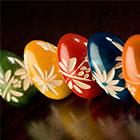 After the Ascension of Christ, Mary supposedly went to the Emperor of Rome and greeted him with "Christ is risen", whereupon he stated, "Christ has not risen no more than that egg is red" (pointing to an egg on his table). After making this statement it is said the egg immediately turned blood red.[citation needed] She then began preaching Christianity to him. The egg is symbolic of the grave and life renewed by breaking out of it. The red symbolizes the blood of Christ redeeming the world, represented by the egg, and our regeneration through the bloodshed for us by Christ. The egg itself is a symbol of the Resurrection while being dormant it contains a new life sealed within it.
The coloring of eggs is a established art, and eggs are often dyed, painted, and otherwise decorated. Eggs were also used in various holiday games: parents would hide eggs for children to find, and children would roll eggs down hills. These practices live on in Easter egg hunts and egg rolls. The most famous egg roll takes place on the White House lawn every year.The oldest tradition is to use dyed and painted chicken eggs, but a modern custom is to substitute chocolate eggs, or plastic eggs filled with confectionery such as jellybeans. Candy Easter eggs can be any form of confectionery such as hollow chocolate eggs wrapped in brightly-colored foil. Some are delicately constructed of spun sugar and pastry decoration techniques. The ubiquitous jelly egg or jellybean is made from sugar-coated pectin candy. These are often hidden, supposedly by the Easter Bunny, for children to find on Easter morning.
The Spanish dish hornazo (traditionally eaten on and around Easter) contains hard-boiled eggs as a primary ingredient. In the North of England, at Eastertime, a traditional game is played where hard boiled pace eggs are distributed and each player hits the other players egg with their own. This is known as "egg dumping" or "egg jarping". The winner is the holder of the last intact egg. The losers get to eat their eggs. It is also practiced in Bulgaria, Croatia, Serbia, the Republic of Srpska and other countries. They call it tucanje. In parts of Bavaria, Austria and German-speaking Switzerland it is called Ostereiertitschen. In South Louisiana this practice is called Pocking Eggs and is slightly different. The Cajuns hold that the winner eats the eggs of the losers in each round.
There are many other decorating techniques and numerous traditions of giving them as a token of friendship, love or good wishes. A tradition exists in some parts of the United Kingdom (such as Scotland and North East England) of rolling painted eggs down steep hills on Easter Sunday. In the U.S., such an Easter egg roll (unrelated to an eggroll) is often done on flat ground, pushed along with a spoon; the Easter Egg Roll has become a much-loved annual event on the White House lawn. An Easter egg hunt is a common festive activity, where eggs are hidden outdoors (or indoors if in bad weather) for children to run around and find. This may also be a contest to see who can collect the most eggs.
Hanácké kraslice, Easter eggs from the Haná region, the Czech Republic, decorated with strawEaster eggs are a widely popular symbol of new life in Ukraine and other Slavic countries' folk traditions. A batik-like decorating process known as pysanka produces intricate, brilliantly-colored eggs. The celebrated Fabergé workshops created exquisite jewelled Easter eggs for the Russian Imperial Court. A 27-foot (9 m) sculpture of a pysanka stands in Vegreville, Alberta.
When boiling hard-cooked eggs for Easter, a popular tan colour can be achieved by boiling the eggs with onion skin. In the North of England these are called pace-eggs or paste-eggs. They were usually eaten after an egg-jarping (egg-tapping) competition.
Deep-fried chocolate Easter eggs are sold around Easter time in Scottish fish and chips shops. The idea was invented in a northeastern Scottish takeaway as a sequel to the extremely popular deep fried Mars Bar.
Recently Easter eggs have been specially prepared keeping in mind those who are visually-impaired. These are called "Beeping Easter eggs" - Easter eggs that emit various clicks and noises so that the visually-impaired children can hunt for them. Some make a single, high-pitched sound and others play a melody. The purpose of this is to include one and all in the joyous Easter celebrations and to spread happiness and goodwill among everyone. After all, that is what Easter is all about.
 Mother's Day
 Buddha Purnima
 Personal Finance Guide
 Multifaceted Blog
 Good Morning
 Dating